

 French
 Spanish
 Russian
Private guide in Pretoria, guided tours in Pretoria, South Africa

Pretoria
South Africa
Language: English
Currency: Rand
Information about Pretoria
Pretoria is the administrative capital of South Africa and one of the country’s most culturally rich cities, blending colonial heritage, African authenticity, and modern political dynamism. Known as the “city of jacarandas and jasmine,” its streets bloom in spring with fragrant purple, pink, and gold canopies. Unlike Johannesburg, Pretoria exudes calm, almost academic elegance: wide boulevards, Victorian architecture, university campuses, and diplomatic residences evoke an “African The Hague.” Pretoria is not about safaris or beaches—it’s about history, politics, botany, and memory: a place to understand contemporary South Africa through the lens of its complex past and diverse present.
The city’s appeal lies in its unique balance of monumentality and intimacy: grand parliamentary buildings neighbor tranquil gardens, apartheid memorials coexist with vibrant street art embodying the “new South Africa.” Attractions are tailored for thoughtful travelers—researchers, students, families wanting to teach children about justice, and couples seeking meaningful engagement over entertainment. Pretoria is especially treasured as South Africa’s “third layer”—beyond Cape Town and Johannesburg—for those wishing to peer behind facades and hear the nation’s unfiltered voice.
- Voortrekker Monument — a tribute to the 19th-century Boer pioneers, featuring frescoes, a sarcophagus, and a solar phenomenon at noon on December 16.
- Pretoria National Botanical Garden — 76 hectares of unique flora, from Kalahari succulents to Knysna forests, with a “Sounds of Nature” trail and observatory.
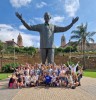
- Union Buildings — the presidential residence and symbol of national unity; on the slope stands a 9-meter-tall Nelson Mandela statue.
- Apartheid Museum (Pretoria Branch, at UP) — an immersive exhibition with personal artifacts, audio testimonies, and a chronicle of resistance.
- St. Michael and All Angels Church — Pretoria’s oldest Anglican church (1876), with reconciliation-themed stained glass and graves of early settlers.
- Kunutu Central Market — the city’s largest craft market: masks, textiles, bronze, beadwork, street food, and live music.
- Paul Kruger House Museum — the Transvaal president’s residence, with original furnishings, hunting trophies, and an 1890 gold-bar vault.
Why explore Pretoria with a private guide in Pretoria?
Many architectural symbols, memorial inscriptions, and political references in street art require deep contextual understanding. Only a private guide in Pretoria can explain why the Union Buildings have 62 steps (commemorating 62 years of apartheid), how the Voortrekker Monument’s light beam relates to the Battle of Blood River, or where Churchill was held as a POW. Moreover, a guide arranges access to restricted areas: for instance, the Monument’s archive holding Boer women’s diaries, or the Union Buildings’ terrace with panoramic views (by prior application). Services by private guides in Pretoria also include meetings with anti-apartheid activists—offering firsthand historical testimony.
When is the best time to visit Pretoria for maximum impact?
August–November: flowering season—jacaranda, pistachio, jasmine, and bougainvillea. October especially dazzles—the “month of purple rain.” June–July: dry and mild (+18°C), ideal for walking tours and museums. December–February: hot (+30°C), with possible thunderstorms. March–May: “golden autumn”—warm days, cool evenings.
What languages are spoken in Pretoria, and should you book a guide in advance?
Official languages: English, Afrikaans, and Sesotho. Museum and government staff speak English, but market and township vendors primarily use local languages. For deep immersion in political and cultural history, a private guide in South Africa is strongly recommended—someone fluent in languages and knowledgeable about post-apartheid transformation, northern traditions, and architectural symbolism.
What local dishes and drinks should you try in Pretoria?
Must-tastes include: pap en chakalaka (maize porridge with spicy vegetable relish), morogo (wild spinach and pumpkin soup), Mandela Sauce—a sweet-chili condiment created in the president’s honor—and amarula coffee (coffee with marula-fruit liqueur). At “The Hat & Beard” restaurant, try the signature “Pretoria Gardens on a Plate”: succulent salad, grilled crocodile, marula dessert, and Modder River wine.
What souvenirs can you buy in Pretoria—and what’s restricted for export?
Worth seeking: bronze Voortrekker Monument miniatures, jacaranda-print shweshwe fabric, *Mopane* wood carvings, and Afrikaans books signed by authors. Exporting ivory, rhino horn, wild-animal skins, or rare plants (e.g., *Aloe peglerae*) without CITES and SANBI permits is prohibited. Archaeological artifacts—even pottery shards—are strictly forbidden.
What clothing and footwear are recommended for visiting Pretoria?
For walking: sturdy-soled shoes (many streets are cobblestone). In summer: light cotton clothing, sun hat, UV sunglasses. In winter: warm sweater and windbreaker—mornings and evenings are cool. For government buildings and churches: smart-casual attire (no shorts or open shoes).
What currency is used in Pretoria, and should you carry cash?
South African rand (ZAR). Cards are widely accepted, but cash is required at markets and street performances. ATMs are located near the Union Buildings, Menlyn Park Mall, and Rovos Rail Station.
What etiquette should visitors observe in Pretoria?
At memorials: silence and no flash photography. In gardens: do not pick flowers (especially rare aloes). At markets: polite haggling (max 25% off). Upon entering churches or memorials: remove headwear. Always greet with “Dumela” (Sesotho for “Hello”).
How safe is Pretoria, and what challenges might arise?
The city center is considered safe for tourists during daylight. Main risks: pickpocketing in crowds and disorientation in newer areas (e.g., Atteridgeville). Avoid solo walks after 19:00 outside tourist zones. Always use vetted guides and avoid unlit streets.
How to spend an evening in Pretoria?
In summer: garden dinners at Pretoria Country Club, jazz concerts in the botanical garden, moonlit walks along Jacaranda Street. In winter: wine-and-history tastings by the fireplace at Hatfield House, theater at State Theatre, lectures at Ditsong Library. Every Friday: “Kunutu Night”—music, dance, and weaving workshops.
Will children enjoy Pretoria?
Yes—the botanical garden offers the “Junior Botanist” program: kids identify succulents, make herbariums, and feed turtles. At the Monument: the “Mandela Quest”—a scavenger hunt tracing key life events. At the market: mask-painting and bracelet-weaving workshops. In summer: “Garden Night”—bat watching and Southern Hemisphere constellation stories.
Who lives in Pretoria, what are the religious practices, and population size?
Metropolitan population: over 2.5 million. Predominantly Pedi, Tswana, and Zulu communities, with Afrikaner, Indian, and Chinese minorities. Main religions: Christianity (Protestantism and Catholicism), Islam, and African traditional beliefs. The “Day of Reconciliation” (December 16) continues—with interfaith prayers, concerts, and a national shared meal.
What is the environmental situation in Pretoria?
Good, thanks to extensive green zones. The city runs the “Green Capital” program: solar panels on government buildings, Apies River cleanup, and plastic-bag bans in parks. Tap water is potable. Noise pollution levels are among the lowest for major South African cities.
How to reach Pretoria: which city and airport to fly into?
Nearest international airport: O.R. Tambo (JNB) in Johannesburg, 50 km away. From there: rental car (~40 min via N1), Gautrain to Pretoria Station (~25 min), or taxi (Uber/Bolt). Alternatively, fly into Wonderboom Airport (PRY), though it serves domestic flights only. For deeper engagement, book a transfer and guided tour via private guides in South Africa—they’ll coordinate expert meetings and tailor the itinerary to your interests.
Why is Pretoria an essential stop on any South African journey?
Pretoria is more than a capital—it’s a living chronicle of South Africa’s rebirth: every stone, monument, and tree speaks of struggle, tragedy, and hope. Here, memory is not museumified—it breathes, debates, and teaches. With a private guide in Pretoria, you won’t just see landmarks—you’ll hear their voices. Book private guides in Pretoria to transform your visit from a tour into a dialogue with history—honest, complex, and inspiring.
What are 5 reasons to visit Pretoria?
- Unique political landscape: from apartheid memorials to Mandela’s residence—all within a 5-km radius.
- Pretoria National Botanical Garden—one of Africa’s finest, emphasizing endemic and endangered species.
- “Jacaranda City”—the spring phenomenon when streets drown in purple bloom: unforgettable and symbolic of renewal.
- Living memory: opportunities to meet anti-apartheid veterans and hear uncensored history.
- Architectural diversity: from Victorian mansions to avant-garde “Rainbow Nation” installations.
Our tips for tourists visiting Pretoria
- Book a private guide in Pretoria for the “Union Buildings Morning Silence”: 6:30—empty avenue walk; 7:00—sunlight illuminating Mandela’s statue; 7:30—breakfast in the gardens with city views.
- Get the “Memory Card” at the Apartheid Museum—grants access to restricted archives, a meeting with a former Robben Island prisoner, and a free 7-language audio guide.
- Photograph the Voortrekker Monument from Magaliesberg Hill at noon on December 16—when the light beam strikes the sarcophagus inside (on other days, by prior arrangement with your guide).
- Visit “Schuster’s” bookstore—the city’s oldest (1912), still selling signed Afrikaans books and original jasmine-pressed bookmarks.
- Walk the “Reconciliation Trail”—a 1.8-km route from the Monument to the Union Buildings, where each bench features an engraved Mandela quote on forgiveness (Russian audio via the “Pretoria Voices” app).